
Economy

January 13, 2014
Currency Update in January
Written by Peter Wright
The Federal Reserve publishes a trade weighted index of the value of the US$ against a basket of the currencies of our major trading partners weekly and monthly. The H.10 weekly release contains daily rates of exchange of major foreign currencies against the U.S. dollar. The data are noon buying rates in New York for cable transfers payable in the listed currencies. The rates have been certified by the Federal Reserve Bank of New York for customs purposes as required by section 522 of the amended Tariff Act of 1930. Steel Market Update uses this information to construct a currency comparison for multiple countries.
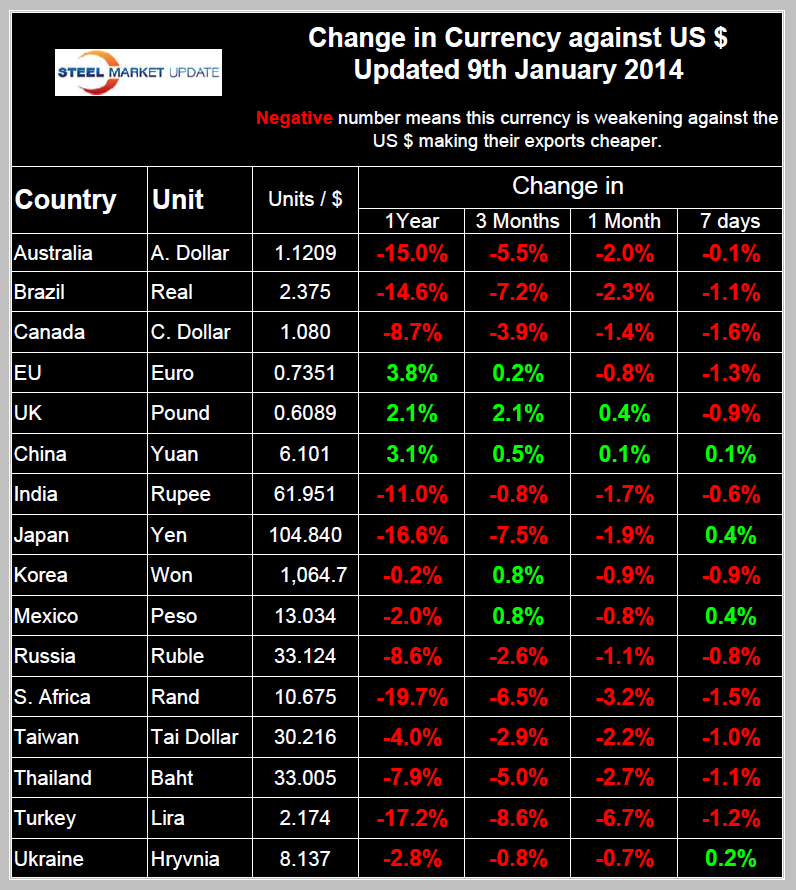
The Broad Index has been strengthening steadily for 18 months and is now up by 8.9 percent since May 2nd 2011. In the last 12 months through January 9th the BI is up by 3.6 percent. This widely reported data is useless for the consideration of iron ore and finished steel product trade. Simply put, steel trading currencies have a life of their own and are wildly more volatile than the BI. On a simple arithmetic (non weighted) basis the currencies of the steel and iron ore trading nations have declined by more than twice the BI with Australia, Brazil, India, Japan, South Africa and Turkey all having experienced double digit declines. Table 1 summarizes the currency fluctuations of 16 nations over 1 year, 3 month, 1 month and 7 day periods to give both a sense of the magnitude and direction of change. Numbers in this table are predominantly red indicating weakening against the greenback. This means that the US is more desirable as an export destination and that US exports are more expensive on the global market thus moving net steel trade in a negative direction. The only currencies that have strengthened against the US$ in the last year are the Euro, the Pound and the Yuan.