
Economy

January 16, 2014
Producer Price Indexes of Sheet Steel and Competing Materials
Written by Peter Wright
Each month the Bureau of Labor Statistics puts out its series of producer price indexes (PPI), for thousands of goods and materials. The latest release on Wednesday reported December results. These statistics are a useful way to evaluate any changes in the competitive position of steel against competing materials. See below for the official description of this program. Overall prices for finished goods declined 0.1 percent in November and 0.2 percent in October. At the earlier stages of processing, prices received by producers of intermediate goods rose 0.6 percent in December, and the crude goods index climbed 2.4 percent. On an unadjusted basis, prices for finished goods increased 1.2 percent in 2013 compared with a 1.4 percent advance in 2012.
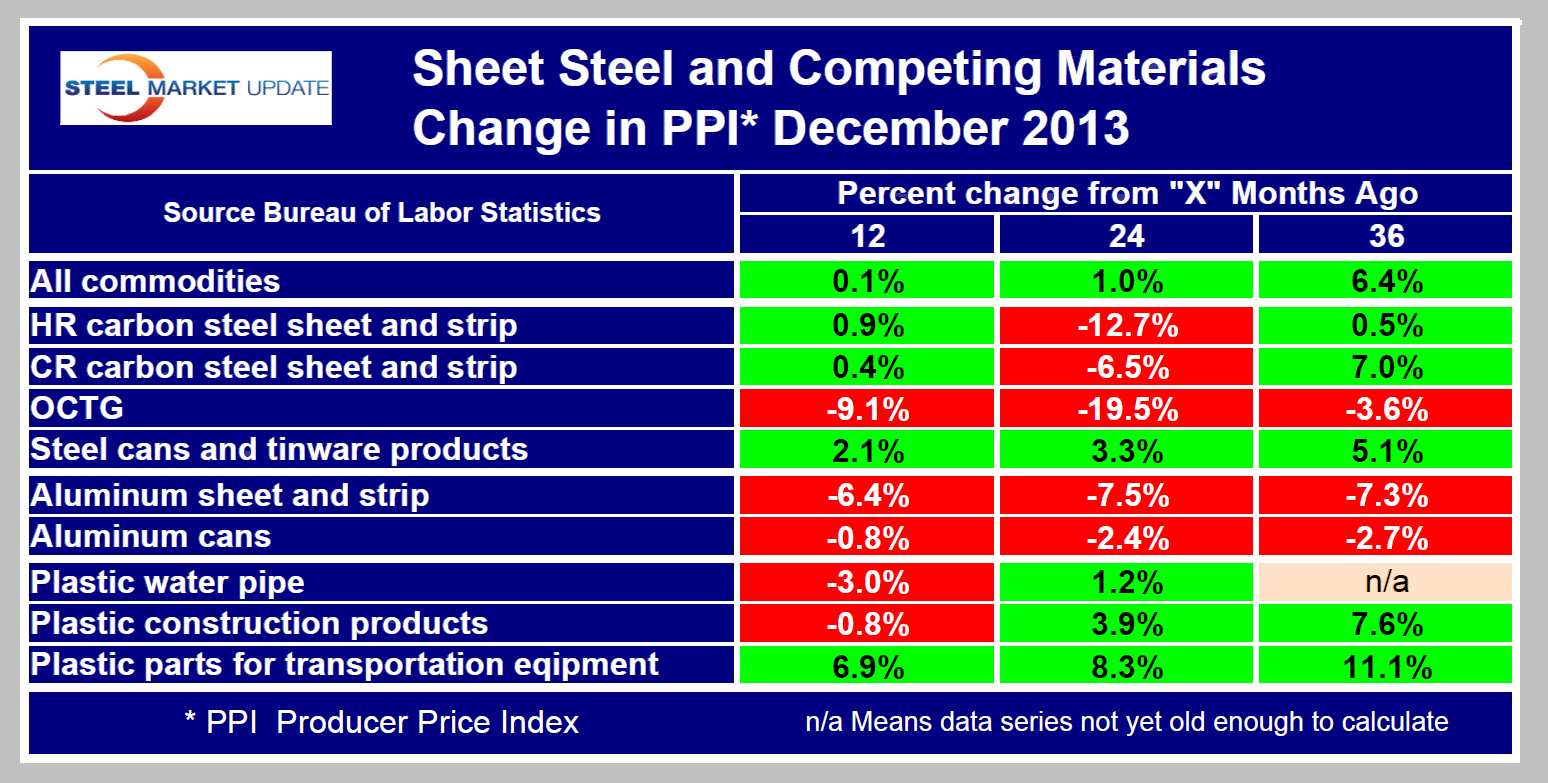
For the purpose of this report, SMU extracts comparative statistics for sheet steel, aluminum and plastic products. Table 1 is a summary of steel, aluminum and plastic indexes on a year over one, two and three year’s basis. One cell in this table contain the code n/a. In the last two years the BLS has expanded its range of products within the PPI series with the result that long term comparisons can not yet be made in this product. What the PPI data shows is that the acceleration in commodity prices slowed to 0.1 percent in 12 months through December. Over a 24 month period commodity prices were up by 1.0 percent and by 6.4 percent over 36 months. The price gyrations of hot and cold rolled sheet don’t bear much relation to the overall commodity grouping. Of special note this week, considering the news from the Detroit auto show, is that the price index of aluminum sheet has declined 6.4 percent in the last year and that decline is accelerating. At the same time the PPI of cold rolled sheet has risen by 0.4 percent. No doubt Ford has decided that long term energy costs in the US will remain low which will have a beneficial effect on the long term price of aluminum. In order to meet government mandated fleet economy ratings the automobile manufacturers are taking the vehicle weight issue very seriously. Ultra high strength steels are competing head to head with aluminum and winning some as they lose others. The future energy economy of the US could work against the competitive position of steel. The price of steel cans and tin ware products is steadily becoming less competitive against aluminum.